Eisenhower in War and Peace by Jean Edward Smith
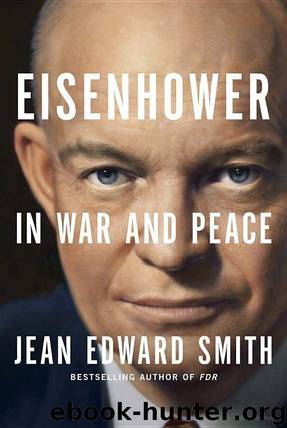
Author:Jean Edward Smith
Language: eng
Format: mobi, epub, azw3
Tags: Non-Fiction, bought-and-paid-for, Biography, History
ISBN: 140006693X
Publisher: Random House
Published: 2012-02-21T05:00:00+00:00
SEVENTEEN
Columbia
Stand Columbia! Alma Mater
Through the storms of Time abide
—GILBERT OAKLEY WARD
Eisenhower stepped down as chief of staff on February 7, 1948, and Omar Bradley was sworn in as his successor. By arrangement with the board of trustees, Ike would assume his duties at Columbia at the end of the academic year, and by agreement with Bradley, he and Mamie would remain at Quarters 1 until he was ready to move to New York.a In the interim, Eisenhower intended to write his memoirs.
Eisenhower had planned to write his memoirs from the time he assumed command of the North African invasion of 1942. Kay Summersby and Harry Butcher had kept diaries for him, Ike occasionally made entries in his own diary, and the staff both at AFHQ and SHAEF had been meticulous in maintaining a record of his activities. Even before the war ended Eisenhower received offers from publishers, but did not take them seriously until toward the end of his tour as chief of staff. “I don’t believe that any man on active duty has the right or the time to undertake the writing of a book of this kind.”1
What Ike did do was set aside evenings at Quarters 1 to reread the Memoirs of Ulysses Grant, which he would use as a model.2 Grant’s lean and elegant prose has often been cited by critics as diverse as Edmund Wilson and Gertrude Stein as the finest nonfiction writing in American literature.3 Grant was generous in his praise and sparing with his criticism, which also appealed to Ike. “I would not indulge in the kind of personal criticism or disparagement of others that had badly marred many military accounts.”4
Negotiations began in earnest in December 1947. Ike was approached by Simon and Schuster and by Harper and Brothers, but eventually signed on with Doubleday, acting in conjunction with the New York Herald Tribune, who made what Eisenhower considered a preemptive offer. Instead of the customary advance against royalties, Doubleday and the Trib proposed to buy all of the rights to Ike’s book in a single package. There would be no royalties, but Eisenhower would receive a lump sum payment of $635,000 upon completion of the manuscript.5 b It was a handshake deal. Ike said a written contract was not necessary.6
Under the arrangement, Eisenhower received roughly the modern equivalent of $6 million, about half of what President Clinton received from Alfred A. Knopf as an advance against royalties for his memoirs. But unlike Clinton’s royalties, Ike’s lump sum payment in 1948 was treated as a capital gain, not as income. That was standard IRS procedure at the time for onetime authors who received a lump sum payment, and Ike received no special consideration.7 It meant that instead of paying income tax at the rate of 82.13 percent, which would have been Ike’s tax bracket, he paid taxes at the capital gains rate of 25 percent.8 That left Ike $476,250, or roughly $4.5 million in today’s dollars, and it made him financially independent. Some biographers
Download
Eisenhower in War and Peace by Jean Edward Smith.epub
Eisenhower in War and Peace by Jean Edward Smith.azw3
This site does not store any files on its server. We only index and link to content provided by other sites. Please contact the content providers to delete copyright contents if any and email us, we'll remove relevant links or contents immediately.
| Afghan & Iraq Wars | American Civil War |
| American Revolution | Vietnam War |
| World War I | World War II |
Waking Up in Heaven: A True Story of Brokenness, Heaven, and Life Again by McVea Crystal & Tresniowski Alex(37811)
Empire of the Sikhs by Patwant Singh(23086)
We're Going to Need More Wine by Gabrielle Union(19046)
Hans Sturm: A Soldier's Odyssey on the Eastern Front by Gordon Williamson(18592)
Leonardo da Vinci by Walter Isaacson(13336)
The Radium Girls by Kate Moore(12028)
Tools of Titans by Timothy Ferriss(8396)
Educated by Tara Westover(8054)
How to Be a Bawse: A Guide to Conquering Life by Lilly Singh(7486)
Permanent Record by Edward Snowden(5847)
The Last Black Unicorn by Tiffany Haddish(5636)
The Rise and Fall of Senator Joe McCarthy by James Cross Giblin(5280)
Promise Me, Dad by Joe Biden(5153)
The Wind in My Hair by Masih Alinejad(5095)
A Higher Loyalty: Truth, Lies, and Leadership by James Comey(4964)
The Crown by Robert Lacey(4817)
The Iron Duke by The Iron Duke(4356)
Joan of Arc by Mary Gordon(4110)
Stalin by Stephen Kotkin(3966)
